
In-person course
Ultrasound-Guided Vascular Access Course (Half Day)
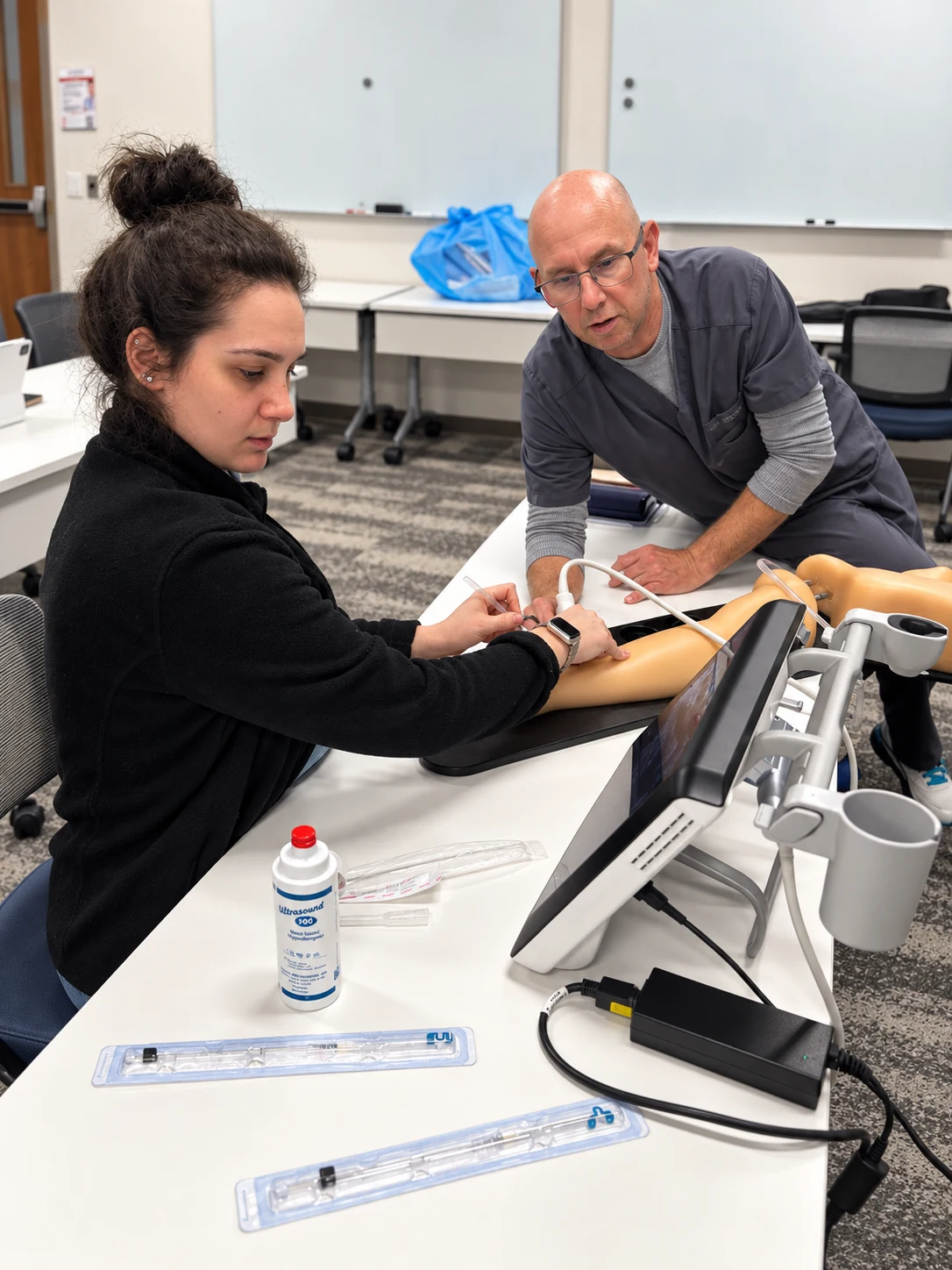
Ultrasound-guided peripheral IV, arterial cannulation and central venous access on live models and simulator phantoms. Half day, small groups.
Half daySmall groupsLive models and simulator phantoms
See the vessel.Guide the needle.Place the line.
A comprehensive review of ultrasound fundamentals, guidance techniques, ultrasound vessel differentiation, procedural set-up, and in-plane and out-of-plane scanning techniques for performing central and peripheral line placement.
Guidance techniques
Direct vs indirect, in-plane vs out-of-plane, vessel differentiation
Central line placement
IJ, axillary/subclavian and femoral vein access
Peripheral line placement
Antecubital vein access, PICC lines/midlines and additional access sites
Topics
- Direct vs indirect techniques
- In-plane vs out-of-plane techniques
- Principles of vessel differentiation and procedural tips
- Ultrasound-guided central line placement
- IJ, axillary/subclavian and femoral vein access
- Ultrasound-guided peripheral line placement
- Antecubital vein access
- PICC lines/midlines
- Additional access sites
Learning objectives
- Cite the interaction of sound with soft tissue and other mediums.
- State the relationship of transducer frequency to resolution, penetration and attenuation.
- List different types of transducers and their selection for different applications.
- Optimize system parameters to maximize resolution and improve diagnostic accuracy.
- Recognize commonly seen imaging artifacts.
- Demonstrate the participant's knowledge to better perform ultrasound-guided vascular access procedures.
- Demonstrate proper transducer manipulation and system optimization to produce diagnostic images.
- List the advantages and disadvantages of the in-plane and out-of-plane, and the direct vs indirect, ultrasound-guided vascular access techniques.
- Differentiate venous vs arterial anatomy by ultrasound.
- Identify ultrasound imaging characteristics of vessels and contiguous anatomy to determine the optimal approach for vascular access.
- Describe ultrasound imaging characteristics of vascular pathology that would indicate a vessel is not suitable for vascular access.
- Demonstrate the use of ultrasound guidance for central line vascular access.
- Demonstrate the use of ultrasound guidance for peripheral line vascular access.
- Demonstrate competence to incorporate protocols, scan techniques and interpretation criteria to improve diagnostic and treatment accuracy.
$300per participant
Book your seat